¶ About M&R
The M&R system is a web-based software system through which public bodies and schools report energy, emissions and related data to SEAI each year to enable SEAI to track each organisation's progress towards energy and climate policy targets.
¶ Benefits for public sector organisations
The M&R system offers several benefits to your organisation:
- Enables your organisation to fulfill its legal obligations to report energy management and performance data to the SEAI on an annual basis (SI 426 of 2014).
- Provides a summary of your organisation’s overall energy consumption.
- Provides a summary of your organisation's greenhouse gas emissions.
- Provides access to your organisation’s electricity and natural gas consumption data for recent years.
- Shows your organisation's progress towards the 2030 energy efficiency target, and your gap to this target.
- Shows your organisation's progress towards the 2030 greenhouse gas reduction targets, and your gap to these targets.
- Allows comparison with the progress of other public bodies in achieving targets.
- Showcases your achievements.
It also helps you understand your organisation's energy consumption, target areas for improvement, identify opportunities, review progress, monitor and benchmark performance and validate savings.
¶ Reporting requirements
¶ Public bodies
Every public body is required to report the following data annually for its organisation:
- Annual energy consumption data, broken down by energy type, including all thermal, transport and electricity consumption.
- Annual values for the organisation's activity levels, including the number of full-time equivalent (FTE) employees and floor area.
- Brief commentary on the organisation's energy management practices and energy performance for the year.
- Name and contact details of the organisation's CEO (or equivalent).
- Details of energy-saving projects, both implemented and planned.
- Building register, including location, type and size information for all buildings, and building-level consumption data for larger buildings.
- A breakdown of the organisation’s vehicle fleet, and details on all vehicle procurements since 2021.
- Business travel undertaken since 2021, including distance travelled by private road vehicle and details of flights taken.
- Details on the organisation’s compliance with the public sector Climate Action Mandate. Neither local authorities nor commercial semi-state bodies are required to report on their compliance with the Climate Action Mandate via M&R.
In addition, public bodies can optionally report data on:
- Business travel by public transport undertaken since 2021.
- Energy expenditure.
- Asset-level energy consumption.
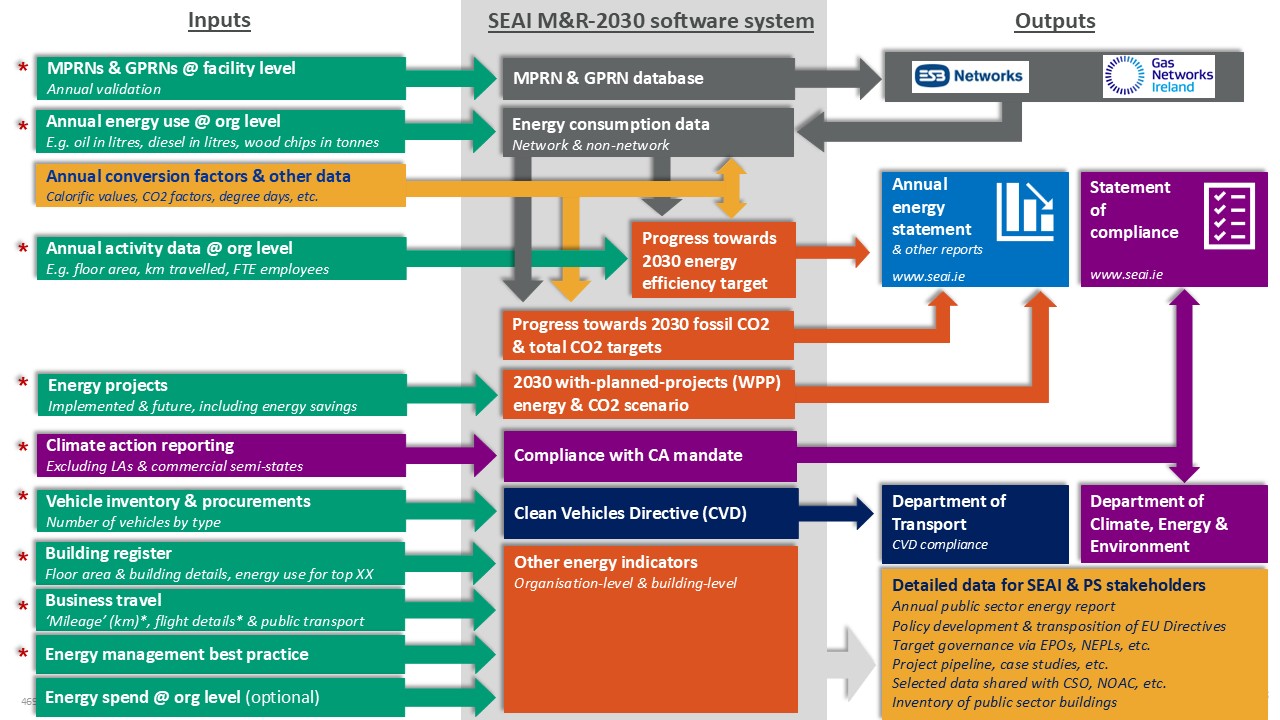
The reporting requirements for public bodies are summarised below.
¶ Schools
Standalone schools are required to report items 1-5 only.
¶ M&R data outputs
The data collected via the M&R system is used for a variety of purposes, including to track progress towards targets at organisation and national levels, to inform decarbonisation planning and investment decision-making and for statistical purposes. The key data outputs include:
- Organisation-level data reports within the M&R system that enable public bodies and schools to understand their energy and emissions profiles, to track their progress towards the 2030 targets and to inform their planning for decarbonisation and energy efficiency.
- Organisation-level data reports that are published on SEAI’s website, including an Annual Energy Statement for every public body and school which summarises the organisation’s progress towards the targets.
- SEAI’s Annual Report on Public Sector Energy Performance, which provides an overview of the public sector’s progress towards the targets, analyses public sector energy use and emissions, showcases the achievements of individual public bodies and lists every organisation’s progress to date.
- Departmental scorecards, which are prepared annually for the energy performance officers (EPOs) within each Government department and summarise the progress to date of every public body that is under the aegis of the relevant department.
- Datasets on the public sector vehicle inventory and vehicle procurements, which is shared with the Department of Transport for the purposes of monitoring Ireland’s compliance with the Clean Vehicles Directive.
- Datasets on public sector energy consumption, broken down by organisation and energy type, which is shared with the Central Statistics Office.
- Key performance indicators for local authorities (progress towards each of the three 2030 targets), which is shared with the Local Government Management Agency and the National Oversight & Audit Commission.
- Building-level datasets from the building register, which is shared with organisations that have decarbonisation planning roles for large estates within the public sector, including the Health Service Executive (HSE), the Department of Further & Higher Education, Research, Innovation & Science (DFHERIS), the Department of Education & Youth, the Office of Public Works (OPW) and the County and City Management Association (CCMA).
- Various datasets that are shared with different SEAI programmes and departments, to support efficiency and decarbonisation planning, to facilitate programme development, to inform modelling and projections, and for statistical purposes.
- Datasets that are shared in response to ad hoc data requests from Government departments and public bodies that have responsibility for energy efficiency, decarbonisation and climate policy in the public sector.